Quick Summary: Revered across India as the undisputed “King of Fruits,” mango is celebrated worldwide for its honeyed sweetness and sun-kissed aroma. Beyond its luscious taste, mango provides over 80% of your daily Vitamin C, natural carotenoids for crystal-clear vision, and gentle digestive enzymes that help break down heavy meals. To get the maximum health benefits and avoid skin breakouts, there is one essential kitchen rule you must follow: always soak fresh mangoes in water before eating!
📋 Table of Contents
- What is Mango? Famous Indian Varieties
- The 30-Minute Water Soaking Secret: Why You Must Never Skip It
- Whole Fresh Mango vs. Mango Shake (The Blood Sugar Reality)
- Nutrition Facts (What is Inside a Mango?)
- Top 5 Proven Health Benefits of Mango
- How to Select, Wash, and Store Mangoes
- Who Should Be Mindful with Mangoes?
- Frequently Asked Questions
- Scientific References
🔍 What is Mango? Famous Indian Varieties
Mango (Mangifera indica) originated in South Asia over 4,000 years ago. Today, India grows more than 1,000 varieties of mango, each possessing its own unique aroma, sweetness, and texture:
- Alphonso (Hapus): Hailing from Maharashtra’s coastal Ratnagiri and Devgad belts, Alphonso is world-famous for its fiberless, saffron-orange flesh, buttery texture, and rich, royal aroma.
- Kesar: Grown in the foothills of Gir, Gujarat, Kesar is nicknamed the “Queen of Mangoes” for its intense sweet scent and vibrant orange pulp, perfect for traditional aamras.
- Dasheri: A beloved northern treasure from Malihabad (Uttar Pradesh), Dasheri features a slender shape, paper-thin skin, and intensely sweet, aromatic yellow flesh.
- Langra: Famous in Varanasi and Bihar, Langra stays bright green even when fully ripe, delivering a complex sweet-tangy burst of flavor with tender fiber.
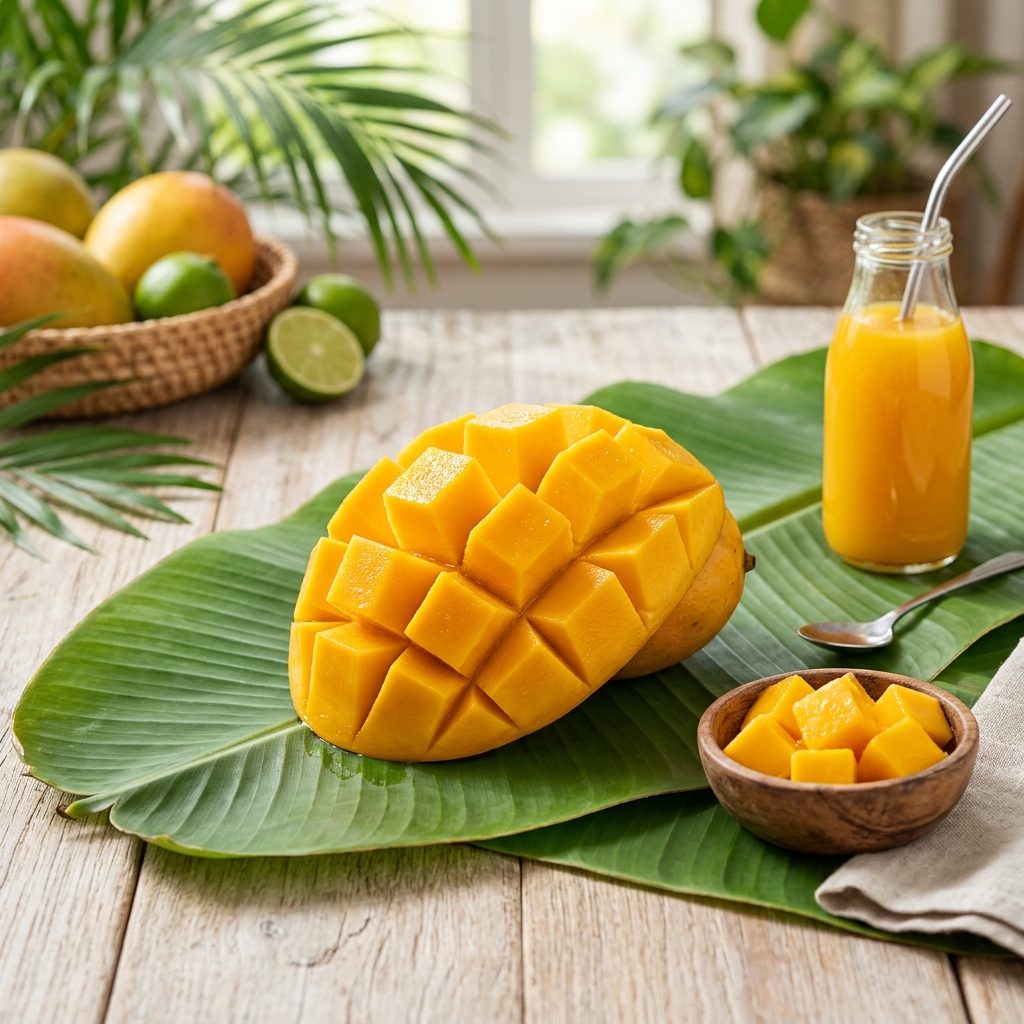
- Banganapalli (Safeda): The pride of Andhra Pradesh, this large, oval golden mango has firm, meatier flesh with virtually no stringy fiber, making it easy to slice into clean cubes.
- Chaunsa: Originating from northern India and Punjab, Chaunsa is harvested late in the summer and delivers honey-sweet, dripping juice with a heavenly fragrance.
🧪 The 30-Minute Water Soaking Secret: Why You Must Never Skip It
For generations, Indian elders have insisted on immersing mangoes in a bucket of cold water for 30 to 60 minutes before cutting them. Modern food science completely validates this ancient habit for three important reasons:
💡 Why Soaking Mangoes is Essential:
- 1. Leaches Out the Irritating Stem Sap (Chep): When mangoes are plucked from the tree, a milky, oily resin called chep oozes from the pedicel stem. This sap contains urushiol-like compounds and mangiferin latex. If you bite into an unsoaked mango, residual sap can cause itchy contact dermatitis, burning lips, and uncomfortable mouth sores. Soaking draws this sap out safely into the water.
- 2. Balances Natural Thermogenic Heat: In traditional Ayurvedic medicine, mangoes are considered thermogenic (producing “ushna” or internal body heat). If consumed straight in the peak of summer, they can trigger minor heat boils or acne in sensitive people. Submerging them in water cools their energetic heat.
- 3. Reduces Phytic Acid Anti-Nutrients: Like many seeds and tree fruits, mango skin contains small amounts of phytic acid that can bind to minerals. Soaking reduces phytic acid, allowing your digestive system to absorb 100% of the fruit’s zinc, iron, and calcium.
🥤 Whole Fresh Mango vs. Mango Shake (The Blood Sugar Reality)
Many people love drinking thick mango milkshakes topped with ice cream during the summer. While delicious as an occasional treat, here is what human metabolism reveals:
| Factor | Whole Fresh Mango (1 Cup Diced) | Commercial Mango Milkshake (1 Large Glass) |
|---|---|---|
| Natural Fiber | 2.6 g to 3.0 g (intact plant cell walls) | Fiber broken down by blender blades (under 1 g) |
| Added Refined Sugar | 0 grams (100% natural fruit sugars) | 20 to 35 grams of white sugar added |
| Blood Sugar Impact | Moderate, steady release into bloodstream | Rapid spike in blood glucose and insulin rush |
| Satiety & Fullness | Keeps you satisfied for 2 to 3 hours | Leaves you feeling sluggish and hungry shortly after |
Healthy Kitchen Tip: If you love smoothies, blend fresh mango cubes with a bowl of homemade probiotic Curd (Dahi), a pinch of roasted Cumin Seeds, and a spoonful of pre-soaked Chia Seeds. This creates a refreshing traditional lassi rich in healthy protein, fiber, and live cultures without needing any white refined sugar!
📊 Nutrition Facts (What is Inside a Mango?)
Mango is exceptionally nutrient-dense while remaining free of cholesterol and sodium. Here is the nutritional breakdown per 100 grams of fresh pulp and per medium mango (~200 grams edible portion):
| Nutrient | Per 100g Pulp | Per 1 Medium Mango (~200g) | Why Your Body Needs It |
|---|---|---|---|
| Energy | 60 kcal | 120 kcal | Wholesome, clean fruit energy |
| Carbohydrates | 15.0 g | 30.0 g | Natural fructose and glucose fuel |
| Dietary Fiber | 1.6 g | 3.2 g (11% DV) | Feeds gut flora and regulates bowel transit |
| Protein | 0.8 g | 1.6 g | Light plant amino acids |
| Vitamin C | 36.4 mg (40% DV) | 72.8 mg (81% DV!) | Powerful antioxidant and collagen booster |
| Vitamin A (Beta-Carotene) | 54 mcg RAE (6% DV) | 108 mcg RAE (12% DV) | Crucial for night vision and epithelial lining |
| Folate (Vitamin B9) | 43 mcg (11% DV) | 86 mcg (22% DV) | Vital for cellular repair and red blood cells |
| Potassium | 168 mg | 336 mg (7% DV) | Helps balance cellular fluids and blood pressure |
🌿 Top 5 Proven Health Benefits of Mango
1. Exceptional Immune Defense
Just one medium mango supplies more than 80% of your daily required Vitamin C. Vitamin C activates white blood cell production (neutrophils and lymphocytes) to fight off seasonal viral infections. Combined with Vitamin A, it fortifies your mucous membranes against pathogens.
2. Crystal-Clear Vision & Skin Radiance
The radiant yellow-orange hue of mango flesh comes from natural carotenoids, specifically beta-carotene, lutein, and zeaxanthin. These plant pigments concentrate in the macula of your eyes, filtering out harmful blue light from computer screens and defending against age-related retinal damage.
3. Gentle Digestive Relief
Mango contains a special family of digestive enzymes called amylases. These enzymes actively break down complex carbohydrates and starches into simple sugars, easing the workload on your stomach and pancreas after meals.
4. Heart Health & Blood Vessel Tone
With 336 mg of natural potassium and a healthy dose of magnesium per fruit, mango naturally counteracts the high sodium present in modern diets. Potassium helps blood vessels relax, supporting healthy arterial elasticity and normal blood pressure.
5. Mangiferin: The Cellular Super-Antioxidant
Mango is the primary dietary source of mangiferin, a powerful polyphenol researched extensively for its ability to neutralize inflammatory free radicals, protect liver cells, and support balanced cellular longevity.
🛒 How to Select, Wash, and Store Mangoes
- The Scent Test: Gently smell the stem end of the mango. A ripe, sweet mango will give off a rich, floral, sweet fragrance. If it smells completely sour or flat, it was plucked prematurely.
- The Gentle Touch: Hold the mango in your palm and squeeze very gently. It should feel firm yet yield slightly to soft pressure, similar to a ripe avocado. Avoid fruits with squishy, bruised brown indentations.
- Room Temperature Ripening: Never store hard, green mangoes in the refrigerator! Cold temperatures halt the natural ripening process and give the pulp a mealy, rubbery texture. Keep unripe mangoes on the kitchen counter in a brown paper bag.
- Refrigeration: Once fully ripe and fragrant, transfer mangoes to the vegetable crisper drawer in your fridge for up to 4 to 5 days to preserve freshness.
⚠️ Who Should Be Mindful with Mangoes?
- Blood Sugar Management: While mango has a moderate glycemic index (~51), it is naturally rich in carbohydrates. Diabetics can comfortably enjoy 1/2 a small mango (~100g) as an afternoon snack. For optimal glucose stability, pair it with a handful of raw Almonds or Pumpkin Seeds—the healthy fats and proteins will slow glucose absorption. Avoid eating mango right after a heavy rice or chapati meal.
- Stem Sap Allergies: If you frequently develop itchy red lips or tiny pimples around your mouth after eating mangoes, always soak the fruit for an hour and peel the skin generously away from the stem before slicing.
⚡ Check Your Exact Nutrition & Calories
Want to calculate the exact calories, carbohydrates, and fiber in your custom mango serving? Use our free interactive tool:
❓ Frequently Asked Questions (FAQ)
Can people with diabetes eat mango?
Yes, in mindful portions! A portion of 80 to 100 grams (about 1/2 cup diced) contains approximately 15 grams of natural carbohydrates. When eaten alone as a mid-morning snack alongside a few raw almonds, it fits safely into a well-managed diabetic meal plan. Avoid commercial mango juices and sweet mango shakes.
What is the best time to eat mango?
The best time is mid-morning (around 11:00 AM) or as a 4:00 PM afternoon snack. At these times, your metabolism is active and will utilize the fruit sugars as clean physical fuel. Avoid eating large bowls of mango late at night right before going to sleep.
Does eating mango cause acne and heat boils?
Eating unsoaked mangoes straight from the tree can trigger pimples due to the residual milky sap (chep) and thermogenic heat. Always soak mangoes in room-temperature water for at least 30 to 45 minutes before cutting to neutralize these effects completely.
🔬 Scientific References
- USDA FoodData Central: Mangifera indica (Mango, raw), FoodData Central ID: 169910.
- National Center for Biotechnology Information (NCBI / PubMed): Mangiferin: a natural miracle bioactive compound with diverse therapeutic properties. PMID: 28246320.
- Indian Council of Medical Research (ICMR) – National Institute of Nutrition: Nutritive Value of Indian Foods (Mango varieties analysis).
- Journal of Agricultural and Food Chemistry: Carotenoid composition and antioxidant capacity of Indian mango cultivars.
Medical Disclaimer: This guide is published for educational and nutritional awareness only. It is not intended to replace personalized medical diagnosis, dietary prescription, or diabetes treatment. Always consult a certified dietitian or physician regarding personal dietary changes.