Quick Summary: Black Pepper (known as Kali Mirch in Hindi) is rightfully crowned the “King of Spices.” Indigenous to the rainforests of Kerala’s Malabar coast, black pepper was once worth more than its weight in pure gold and drove the global spice trade for centuries. Beyond its sharp, pungent bite and warm woody aroma, black pepper contains piperine—a remarkable natural compound that dramatically boosts your body’s ability to absorb nutrients from food and herbal remedies.
📋 Table of Contents
- What is Black Pepper? (Where Does It Come From?)
- Black vs. White vs. Green Peppercorns
- The Piperine Superpower: The Ultimate Nutrient Bio-Enhancer
- Nutrition Facts (What is Inside Black Pepper?)
- Proven Health & Digestion Benefits
- The Fresh-Crush Rule: Why Pre-Ground Pepper Loses Its Magic
- Traditional Home Remedies for Cough & Sore Throat
- How to Store Whole Peppercorns for Up to 3 Years
- Who Should Be Mindful with Black Pepper?
- Frequently Asked Questions
- Scientific References
🔍 What is Black Pepper? (Where Does It Come From?)
Black pepper (Piper nigrum) is the dried fruit of a perennial flowering vine native to the Western Ghats of Kerala, South India. The vine climbs up tall trees, producing long hanging clusters of round berries.
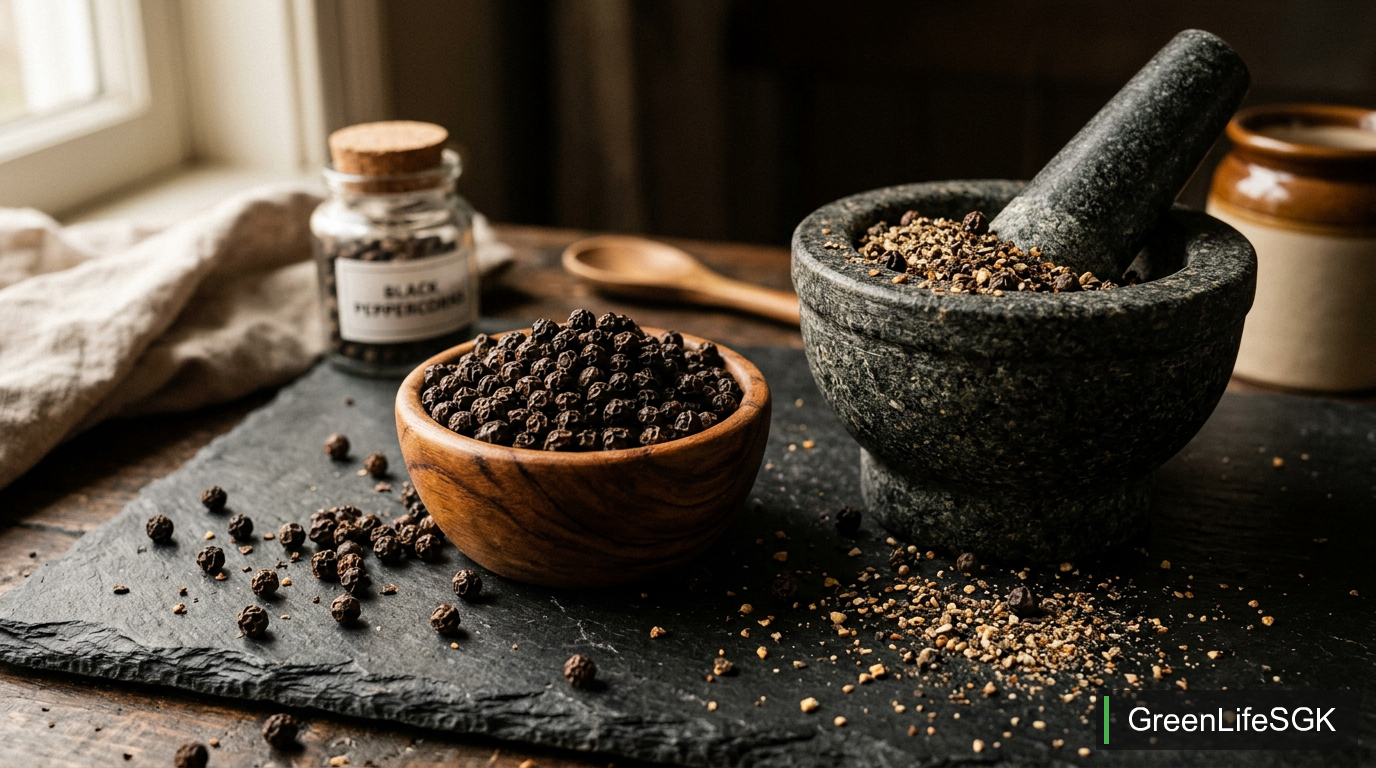
To produce black pepper, the berries are harvested while still green and underripe. They are briefly boiled and then spread under direct hot tropical sunlight for several days. As they dry, the outer skin ferments, shrinks, and wrinkles into the dark, aromatic black peppercorns we know today.
🌿 Black vs. White vs. Green Peppercorns
Did you know that black, white, and green peppercorns come from the exact same plant? The difference is simply when they are picked and how they are processed:
- Black Pepper: Picked green and sun-dried until the skin turns black and wrinkled. It has the strongest heat, richest essential oils, and deepest woody aroma.
- White Pepper (Safed Mirch): Fully ripe red berries are soaked in running water to completely remove the outer black fruit skin, leaving only the inner seed. It has a sharper, more fermented heat and is used in creamy white gravies and soups where black specks are undesirable.
- Green Peppercorns: Unripe berries that are freeze-dried or pickled in brine to preserve their fresh, herbaceous, citrusy brightness.
- Tellicherry Pepper (Malabar Coast): Considered by chefs to be the finest black pepper in the world. Only the largest, plumpest berries left on the vine to ripen longer are graded as Tellicherry, giving them an exceptionally sweet, complex, and floral heat.
🧪 The Piperine Superpower: The Ultimate Nutrient Bio-Enhancer
Black pepper does something no other kitchen spice can do: it acts as a biological absorption amplifier for your entire digestive system.
💡 The Piperine Miracle:
- The Active Compound: The sharp, tongue-tingling heat of pepper comes from an alkaloid called piperine.
- Supercharges Curcumin Absorption by 2,000%: Curcumin (the active ingredient in turmeric) is notoriously hard for humans to absorb. Clinical trials have proven that combining just a pinch of black pepper with turmeric multiplies curcumin bioavailability in the human bloodstream by up to 2,000% [1]!
- Boosts Vitamins & Minerals: Piperine stimulates the brush border of your small intestine, increasing your uptake of Beta-Carotene, Vitamin B6, iron, and selenium from the foods you eat alongside it.
📊 Nutrition Facts (What is Inside Black Pepper?)
Here is what you get in 100 grams of whole black peppercorns and per typical everyday serving (1/2 teaspoon freshly cracked / ~1.5 grams):
| Nutrient | Per 100g | Per 1/2 Teaspoon (~1.5g) | Why Your Body Needs It |
|---|---|---|---|
| Energy | 251 kcal | 4 kcal | Virtually calorie-free |
| Dietary Fiber | 25.3 g | 0.4 g | Supports digestive motility |
| Manganese | 12.8 mg | 0.19 mg (8% DV) | Essential for bone metabolism |
| Vitamin K | 164 µg | 2.5 µg (2% DV) | Supports healthy blood clotting |
| Iron | 9.7 mg | 0.15 mg | Trace essential minerals |
| Piperine | 5,000 – 9,000 mg | 75 – 135 mg | The primary nutrient amplifier |
Sources: USDA FoodData Central & ICMR.
🌱 Proven Health & Digestion Benefits
- Stimulates Stomach Acid for Smooth Digestion: Piperine stimulates taste buds on your tongue to signal your stomach to release more hydrochloric acid (HCl). This acid is essential for breaking down heavy proteins and preventing food from fermenting in your gut, eliminating indigestion and gas [2].
- Natural Respiratory Relief: Freshly cracked black pepper with raw honey is a time-tested Ayurvedic remedy that naturally breaks down chest congestion, clears blocked sinuses, and calms irritating tickles in the throat.
- Potent Natural Antioxidant: Black peppercorns are packed with volatile essential oils (pinene, limonene, caryophyllene) that neutralize free radicals throughout the body.
🧪 The Fresh-Crush Rule: Why Pre-Ground Pepper Loses Its Magic
If you buy pre-ground black pepper in a shaker bottle from the supermarket, you are missing out on 80% of what makes pepper amazing.
The Science of Essential Oils: The volatile aromatic oils in pepper (which provide the citrusy, piney, woody aroma) evaporate within 30 to 60 days once the peppercorn is pulverized into powder. What remains in that old shaker is just flat, harsh, dusty heat. Always buy whole peppercorns and crush them freshly in a pepper mill or stone mortar right before cooking or serving!
🍯 Traditional Home Remedies for Cough & Sore Throat
The 2-Minute Kali Mirch & Honey Throat Soother:
- Take 1/4 teaspoon of freshly cracked black pepper powder.
- Mix with 1 teaspoon of raw organic honey and a pinch of turmeric.
- Lick slowly from a spoon twice daily. The honey coats and lubricates the irritated throat lining while the pepper stimulates blood flow and clears mucus immediately!
📦 How to Store Whole Peppercorns for Up to 3 Years
Whole dried peppercorns are incredibly durable. Kept in a tightly sealed glass jar in a cool, dark kitchen pantry away from moisture, whole peppercorns will retain their full heat, essential oils, and aroma for up to 3 to 4 full years!
⚠️ Who Should Be Mindful with Black Pepper?
- Active Gastric Ulcers: Because pepper stimulates stomach acid production, individuals with active stomach ulcers or severe acid reflux should use it in mild, cooked moderation.
- Avoid Burning in Smoking Oil: Like all spices, pepper should be added towards the middle or end of cooking to preserve its delicate aromatics.
💬 Frequently Asked Questions
Why does black pepper make people sneeze?
When microscopic specks of ground pepper touch your nasal lining, the active compound piperine gently stimulates your sensory nerve endings. Your brain registers this as an airborne irritant and triggers a natural sneeze to blow it out!
Can I take black pepper with water on an empty stomach?
A pinch of freshly ground black pepper in warm lemon water or green tea is a great morning habit to awaken digestion, but avoid taking large amounts on an empty stomach to prevent mild burning.
📚 Scientific References
- Shoba, G., et al. (1998). Influence of piperine on the pharmacokinetics of curcumin in animals and human volunteers. Planta Medica, 64(4), 353–356. PubMed: 9619120
- Srinivasan, K. (2007). Black pepper and its pungent principle-piperine: a review of diverse physiological effects. Critical Reviews in Food Science and Nutrition, 47(8), 735–748. PubMed: 17987447
⚖️ Simple Disclaimer
The culinary, storage, and health facts on GreenLifeSGK are provided for daily kitchen education and home wellness. Natural spices support good health, but do not replace certified medical treatment. Speak with a healthcare provider for personalized medical advice.